Last night, I watched the movie Tangled, an enjoyable film. In one scene, the MC tells several scary-looking men about her dream, and they begin sharing their's (a lovely return to the idea that there's a little good in all of us). It was nice. Later in the movie, a character remarked that the when one finishes one dream, the nice thing is that one gets a new dream.
This made me think. Because that's what all characters have. They have a dream, something they want more than anything else in the world. Maybe it's not what they're doing right now, maybe it's not something they think can ever happen, but it's something that's in there.
My present MC had a dream (live happily ever after with her husband). It fell off in the middle (she's pretty sure he's dead). She got a new dream (save her dad's life). Her dreams keep her going when all the other things are going horribly wrong.
Dreams are good for characters. They're definitely good for keeping them going. After all, they're something to hope for when everything else has already gone completely to heck (as things tend to do when a writer is in control and trying to raise the tension).
I've got a dream. It's got something to do with the stuff I tend to yammer about on the blog. As we might have guessed.
What about your characters? What do they dream about? What's your dream?
Showing posts with label movies. Show all posts
Showing posts with label movies. Show all posts
Wednesday, August 17, 2011


Monday, June 20, 2011
Did We Read the Same Source Material?
Ever go see a movie based on a book you really like and walk out thinking, "I'm sorry, did we read the same book?" Characters have disappeared or been created, entire story arcs were cut or doubled in size, moments of deep symbolic meaning or absolutely no meaning whatsoever materialized from nowhere while deeply meaningful moments vanished in a puff of smoke.
I think we've all been there. And, if you're like more, you tend to leave the theater in something of a huff. It's very rare that I leave a theater having seen a flick that made radical changes to the text where I didn't think, "You're not seriously claiming that was based on the book? You barely nodded to the original text!"
Because for me, there's a line between Based On, Inspired By, and Loosely Connected To (See How We Kept The Names the Same).
I'm not saying I've never seen it well done. The movie Stardust in 2007 got very free with Niel Gaiman's novel -- a book I liked quite a bit -- and when I saw many of the changes, I said, "Nice. I see why you did that." Because many of the adaptations were made as concessions to the medium rather than in total disregard for the original text.
On the other hand, Elton John's rock opera version of Aida is, to my mind, more Inspired By Verdi's original than actually based on it. They cut 3 of the acts, change most of Amneris's character arc, and rewrite a fair amount of Radames's backstory. But, you know, they kept the names the same. It's a nice reference, but, to me, almost a different play entirely.
Captain Film Major tends to come to the defense of adaptations. He says I expect them to bear too strong a resemblance to the book. Maybe I do. But that's because I have a very strict interpretation of the line between Based On and Inspired By. I think when you start getting jiggy with the plot, you're crossing over. He doesn't share that opinion.
For the first time, the project I'm working on was inspired by certain source material, and I chose to work closely with that material in the creation of the text. On the other hand, as the piece grew on its own, it moved away from the original source. I'd already changed most names, many motivations, a fair amount of characterization, and the ending. I think I've moved from Based On to Inspired By and, who knows, maybe even closer to Connected To (See How I Make All Those References). But that's just where the project wants to go.
How about you? Where do you draw the lines of Based On and Inspired By? Do you ever do Based On work? Inspired By?
Monday, January 17, 2011
Kids Are Different
(WARNING: Long post. For abbreviated version, skip down to the paragraph starting with the words "Okay, now that I've gone on.")
Recently, through the power of Netflix streaming, I rewatched the movie Quest for Camelot, which a voice in the back of my mind reminded me I'd once seen at a friends house at least a decade ago. Having rewatched it, I decided that aside from two nice songs, it's only got two real strong points (note: the point of this post is, actually, not to knock the movie).
Firstly, I felt that Warner Bros.'s inclusion a disabled character was, at one point, a step towards acknowledging that there are disabled people in America and saying, "Yes, even disabled people can help save their kingdom from evil." For once, we see a film breaking out of the more common Disney paradigm that the world can only be saved by ridiculously good looking, perfectly abled people (who often have bonus powers from somewhere).
Secondly, Garrett now faced some difficulties the other characters didn't (such as having to flee from a dragon -- which he couldn't see -- by jumping on rocks -- which he couldn't see -- across a pit of lava -- which he couldn't see. Thank goodness for assist birds). This made his struggles as a character all the more engaging. To be blunt,in terms of the story, it rather raised the ante on everything that he had to do. He had a harder time than the female lead, because she could see what she needed to do. Also, his experiences gave him the skills he needs to help save the kingdom. Helpful, that.
Thirdly, his experience of how he'd been treated when he lost his sight shaped his view of himself, her family, and their homeland. These factors all went into the motivations that moved him through the story and escalated the conflict. Garrett manages to both make strong points as to why he shouldn't be defined by his blindness and simultaneously define himself by it. (Oh, character angst.)
Okay, now that I've gone on and on about why Garret is definitely my favorite part of that movie, I'll circle back to my thesis. Namely, the rarity of disabled characters in books and movies. When they're included, it's generally in a "disability genre" and the books focus on being disabled instead of treating disabled characters like the abled ones.
Generally speaking, Disney -- the paragon of "kid appropriate" -- doesn't include things that it thinks will scar little kids, such as scars. Ever notice how the only characters in Disney films that maintain serious injuries throughout a flick are the bad guys?
If 18-20% of Americans are disabled, that would suggest that most kids, if they aren't disabled themselves, know or are related to a person with a disability. So would it really be traumatizing to see a disabled character in a book or movie treated the same as the other characters?
My previous works have not included a large number of disabled characters; however, I do have on character in my head with a disability, and her day will come. Disabilities are a fact of life, even in modern times, and I think it might be nice if books and movies written for kids reflected that.
What do you think? How do you feel about disabled characters in books and movies for kids? Have you ever written a disabled character?
** The title for this post derives from the song "Kids are Different," which is the theme song for the group Kids on the Block, a puppet troupe that teaches children about living with disabilities.
Recently, through the power of Netflix streaming, I rewatched the movie Quest for Camelot, which a voice in the back of my mind reminded me I'd once seen at a friends house at least a decade ago. Having rewatched it, I decided that aside from two nice songs, it's only got two real strong points (note: the point of this post is, actually, not to knock the movie).
- Cary Elwes voicing the leading guy, because, you know, he's Cary Elwes, and his voice ROCKS.
- Garrett (as voice by Cary Elwes) is blind.
Firstly, I felt that Warner Bros.'s inclusion a disabled character was, at one point, a step towards acknowledging that there are disabled people in America and saying, "Yes, even disabled people can help save their kingdom from evil." For once, we see a film breaking out of the more common Disney paradigm that the world can only be saved by ridiculously good looking, perfectly abled people (who often have bonus powers from somewhere).
Secondly, Garrett now faced some difficulties the other characters didn't (such as having to flee from a dragon -- which he couldn't see -- by jumping on rocks -- which he couldn't see -- across a pit of lava -- which he couldn't see. Thank goodness for assist birds). This made his struggles as a character all the more engaging. To be blunt,in terms of the story, it rather raised the ante on everything that he had to do. He had a harder time than the female lead, because she could see what she needed to do. Also, his experiences gave him the skills he needs to help save the kingdom. Helpful, that.
Thirdly, his experience of how he'd been treated when he lost his sight shaped his view of himself, her family, and their homeland. These factors all went into the motivations that moved him through the story and escalated the conflict. Garrett manages to both make strong points as to why he shouldn't be defined by his blindness and simultaneously define himself by it. (Oh, character angst.)
Okay, now that I've gone on and on about why Garret is definitely my favorite part of that movie, I'll circle back to my thesis. Namely, the rarity of disabled characters in books and movies. When they're included, it's generally in a "disability genre" and the books focus on being disabled instead of treating disabled characters like the abled ones.
Generally speaking, Disney -- the paragon of "kid appropriate" -- doesn't include things that it thinks will scar little kids, such as scars. Ever notice how the only characters in Disney films that maintain serious injuries throughout a flick are the bad guys?
- Ex: Scar has a scar for all of Lion King.
- Ex: Dorie's scars from the jelly fish attack only last on scene in Finding Nemo.
- Ex: Mulan. Every good guy in the movie gets seriously beat up on. Does it show? Nope. They bruise once then are magically restored. They can even regrow teeth.
- Exception: In Finding Nemo, Nemo has a bad fin, as does Gill. However, these aspects define the characters. They are not incidental aspects. They are essential aspects.
- Exception: The Hunchback of Notre Dame has a hunchbacked MC. On the other hand, that's the primary thing we learn about his character, and he still loses the girl to an abled, and ridiculously good looking (read: Disney ideal) supporting male.
If 18-20% of Americans are disabled, that would suggest that most kids, if they aren't disabled themselves, know or are related to a person with a disability. So would it really be traumatizing to see a disabled character in a book or movie treated the same as the other characters?
My previous works have not included a large number of disabled characters; however, I do have on character in my head with a disability, and her day will come. Disabilities are a fact of life, even in modern times, and I think it might be nice if books and movies written for kids reflected that.
What do you think? How do you feel about disabled characters in books and movies for kids? Have you ever written a disabled character?
** The title for this post derives from the song "Kids are Different," which is the theme song for the group Kids on the Block, a puppet troupe that teaches children about living with disabilities.
Wednesday, December 22, 2010
All the Little Pieces
The other day, Melissa commented on my post Reblocking = Rethinking that "a great story is made up of X,000 perfect words in the perfect order." At the time, I thought that was quite brilliant. Last night, my family and I were watching our collective favorite Christmas movie, Love Actually, and I realized that the reason I love that movie is that it doesn't just have one, two, or three great moments. No, it has a ton of moments where I end up saying, "Oh, I love this part," or "this is such a good moment," or "ooh, I love this bit."
The truly great stories aren't one absolutely amazing bit. They're made up of x,ooo really good moments in a succession. For one fabulous moment, I'll read the book once and occasionally pick it up and flip right to that chapter. For a ton of good moments, I'll reread the entire book over and over again, because all of it's good and all of it feels worth it.
To sum up: You don't have to create a scene that is so absolutely fantastic that people read it and go, "oh, heavens to hopscotch, I'm never going to be that good - I should just give up." It's better to have a lot of little great moments over and over again. Tiny moments that tug at heart strings or inspire smiles and laughter or make me want to read that bit aloud to a friend total up to a book that moves someone, makes someone laugh every time they read it, and they want to give it to friends. 100 one-pointers is better than 1 ten-pointer.
Thoughts? Are there stories you love that are just a lot of good moments? What are you better at, little moments or big scenes?
Friday, October 22, 2010
Loving and Cheating
To return to the film that inspired this week's posts (in case you didn't know I've been building on a theme), I don't feel bonded to the MCs of Fargo. During one of our perennial debates about this movie, Captain Film Major said to me, "How can you not feel something for her? She's pregnant and investigating a murder, which is dangerous."
To such an argument, all I can say is, "CHEAT!" (Or, to quote Tom Stoppard's Arcadia, "Cheat! Cheat! Cheat! I hope you die!" But I try not to take Fargo that seriously.)
As far as I'm concerned, telling me that I should like a character because they're pregnant is cheating. So is telling me I should like them because they're left handed, have three eyes, or happen to look like my sister. Really, telling me that I should like them for any other reason than that they are a likable person is a cheat.
Much like showing me that your villain is a bad guy by having him kick a dog (and we all know that's a bad idea, right?), it's not okay to tell me that I should like your MC just because he's playing with a dog in the first scene. It's too easy. Maybe he's an ax murderer who happens to own a dog. In which case, you've a decent villain, not a likable hero.
Writing is hard work. I understand that. But there are reasons it's hard, and one of those reasons is that when you slack off, it shows. Really shows. I mean, everyone knows. They know, and when they put down the book, they talk about you. "Can you believe it? So-and-so didn't even bother to characterize the MC. All So-and-so ever says is that the MC really likes puppies. But come on, everyone likes puppies. Lame." **I do not promise that the dialogue will always look exactly like that**
But, here's the deal, most people like puppies and kittens. Most people like babies. Most people feel some empathy for pregnant women, people with disabilities or diseases, and/or people in untenable positions over which they have little control. However, none of these qualities or states of being, should your character possess them and/or be in them, actually constitute a likable person. After all, if you write a serial killer who gets picked on for having three eyes, I'm probably going say, "He's a serial killer. Who cares?"
Therefore, if you say, "You should feel sympathy/empathy/deep personal concern/love for my MC just because she's pregnant/he's in the unfortunate situation of having three arms/dogs love my MC," I'm going to call you a cheat. Most people, I think, would agree with me. Because those aren't likable characters. They're just people I usually feel something for.
I do not have an obligatory Harry Potter reference for this post. Why? Because I don't recall J.K. Rowling ever doing something like this. Good work, J.K. Rowling.
To sum up this week: You want the reader to love your characters. To do this, you'll have to give them something in the character to love. And this something better be something real about the character, not a stock sympathetic attribute, or it will not have the desired effect.
Have you ever run across characters that were more sympathetic type than actually sympathetic? Did this work on you? How did you feel about the character? Did your feelings about this character effect your view of the work as a whole?
Monday, October 18, 2010
You Want My Love
Well, not you specifically. But your character wants it. Or, at least, they should. Here's why.
Okay, obligatory statement of the obvious: Captain Film Major and I disagree on movies. (I know. You're all having heart attacks and dying from that surprise.) But, to bother being specific in this case, we disagree about the movie Fargo.
I highly anticipate that some of you are going to disagree with me about this one, and you can feel free to express that. But, basically, Captain Film Major loves that movie. Me, well, when he made me watch it, I contemplated violence against myself to escape. Nothing serious, just that feeling of, 'Hey, if I stab myself in the eye, can I stop watching now?'
Here's my deal with Fargo: I don't give a flying flamingo about any of the characters. Not one of them. There was no one in the movie to whom I felt an emotional connection. So, though this film is considered a cinema classic, I never want to see it again. It bored the living daylights outta me.
Why? Because when I'm watching a film/reading a book/hearing a story about people I don't care about do things I thereby don't care about, I tend to get bored.
In my experience, most people are the same way. Ever been stuck on a train with a stranger who wants to tell you about their second cousin's root canal? And you're just sitting there thinking, "And I care about this why? I hope this person gets off at the next stop. Please, Whatever Higher Power Happens to Be Listening, please let them get off at the next stop." Whereas, if it's your best friend telling you about their grueling trip to your dentist, you'll probably care more. People tend not to care about the doings and feelings of those to whom they have no connection.
Those rules that apply to strangers on a train apply to characters. If the reader feels no emotional connection to the character, no love, then they're not going to care about the character or anything that happens to him or her. Whereas, if you've made the reader fall in love with/feel great love for the character, then the reader will feel their joy and pain. That's what you're going for. Make the reader suffer, so they can enjoy the success.
Think of it this way: Harry Potter. Harry's a nice, down-trodden kid who gets picked on. So you're rooting for him when he gets to leave. Then he's taken and put into a situation where he's inexperienced and doesn't have a clue what to do, so he's got to maneuver in unfamiliar territory where not everyone is friendly, even t hough you know that since he's nice and down-trodden, this is all really unfair. So you're rooting for him when he makes friends and figuring it all out. (Quidditch!) Then he has to save the world, which is really, really hard, and he's doing his best. So you're rooting for him when he tries. Harry's a nice guy doing his best in a hard situation, so you like him.
Instead, now, picture Draco Malfoy in his place. Draco's an annoying, arrogant jerk. So you don't care about his feelings when Harry tells him to shove off. Then he goes to a school where he's already accorded some respect for being a pure-blood and, by virtue of his blood and wealth, already has some power and friends. So you don't care about any struggles he has at school, since they don't seem that back. Then he wants to get in the way of someone trying to save the world. So you really wish Ron and Harry could push him off a glacier and make it look like an accident.
Getting the reader to love the character's important. So, you're going to have to make the character lovable. Once you've got the reader to love the character, you can lead the reader through the ups and downs of the fascinating story, and the reader will stay interested. Because they care about what happens to the character.
Your characters feeling the love?
How's your writing going? Do you ever have trouble getting readers to love your characters? Have you ever run along characters you just can't care for? How did this effect your reading/viewing/listening experience?
Okay, obligatory statement of the obvious: Captain Film Major and I disagree on movies. (I know. You're all having heart attacks and dying from that surprise.) But, to bother being specific in this case, we disagree about the movie Fargo.
I highly anticipate that some of you are going to disagree with me about this one, and you can feel free to express that. But, basically, Captain Film Major loves that movie. Me, well, when he made me watch it, I contemplated violence against myself to escape. Nothing serious, just that feeling of, 'Hey, if I stab myself in the eye, can I stop watching now?'
Here's my deal with Fargo: I don't give a flying flamingo about any of the characters. Not one of them. There was no one in the movie to whom I felt an emotional connection. So, though this film is considered a cinema classic, I never want to see it again. It bored the living daylights outta me.
Why? Because when I'm watching a film/reading a book/hearing a story about people I don't care about do things I thereby don't care about, I tend to get bored.
In my experience, most people are the same way. Ever been stuck on a train with a stranger who wants to tell you about their second cousin's root canal? And you're just sitting there thinking, "And I care about this why? I hope this person gets off at the next stop. Please, Whatever Higher Power Happens to Be Listening, please let them get off at the next stop." Whereas, if it's your best friend telling you about their grueling trip to your dentist, you'll probably care more. People tend not to care about the doings and feelings of those to whom they have no connection.
Those rules that apply to strangers on a train apply to characters. If the reader feels no emotional connection to the character, no love, then they're not going to care about the character or anything that happens to him or her. Whereas, if you've made the reader fall in love with/feel great love for the character, then the reader will feel their joy and pain. That's what you're going for. Make the reader suffer, so they can enjoy the success.
Think of it this way: Harry Potter. Harry's a nice, down-trodden kid who gets picked on. So you're rooting for him when he gets to leave. Then he's taken and put into a situation where he's inexperienced and doesn't have a clue what to do, so he's got to maneuver in unfamiliar territory where not everyone is friendly, even t
 hough you know that since he's nice and down-trodden, this is all really unfair. So you're rooting for him when he makes friends and figuring it all out. (Quidditch!) Then he has to save the world, which is really, really hard, and he's doing his best. So you're rooting for him when he tries. Harry's a nice guy doing his best in a hard situation, so you like him.
Instead, now, picture Draco Malfoy in his place. Draco's an annoying, arrogant jerk. So you don't care about his feelings when Harry tells him to shove off. Then he goes to a school where he's already accorded some respect for being a pure-blood and, by virtue of his blood and wealth, already has some power and friends. So you don't care about any struggles he has at school, since they don't seem that back. Then he wants to get in the way of someone trying to save the world. So you really wish Ron and Harry could push him off a glacier and make it look like an accident.
Getting the reader to love the character's important. So, you're going to have to make the character lovable. Once you've got the reader to love the character, you can lead the reader through the ups and downs of the fascinating story, and the reader will stay interested. Because they care about what happens to the character.
Your characters feeling the love?
How's your writing going? Do you ever have trouble getting readers to love your characters? Have you ever run along characters you just can't care for? How did this effect your reading/viewing/listening experience?
Monday, October 11, 2010
In Which I Reference Things No One's Seen
When I'm living in the same general vicinity of Captain Film Major, my life develops a refrain: "Are you serious? You haven't seen it? Why haven't you seen anything?" Not necessarily in that order or using those exact words every time, but it happens a lot. In his version of reality, I live in a bubble and have never seen any movies.
When I'm living in the actual world, I end up saying something very strange. Namely, "Are you serious? You haven't seen it? Why haven't you seen anything?" Usually not in that order or using those exact words every time, but it happens often enough and something along those lines.
This might be because, while I haven't watched a lot of TV or movies, and the books I've read aren't always the most mainstream (I hid from Twilight for more than a year), but that's never stopped me from referencing them. I make a lot of references, as it turns out. It's gotten to the point where some of my friends have told me, "If you're about to say, 'have you watched...' or 'have you read...' just assume the answer's no."
This makes me wonder, what references can we really expect people to get? Because, quite frankly, I don't expect everyone else on the planet to understand my insane quoting of West Wing (doesn't mean I don't think everyone should watch it, by the by), and I'm coming to terms with the fact that people don't run around quoting Shakespeare (though every time I realize that I get a little sad inside), but there are some things, I think, should be universally understood.
There are some things that we all walk around expecting people to have a working knowledge of. The plots of classics, such as Romeo and Juliet (though I swear I've seen someone screw that one up). The Bible. Major historical figures. (While kids are more likely to recognize Ronald McDonald than George Washington, I think we're all agreed you should know who he is.)
Then there are some things we don't classify as "important knowledge" but everyone has and you'll be surprised if someone doesn't. For example, Harry Potter. I'm not kidding. If you're not conversant in Harry Potter (and by conversant, I don't mean my level of creepy, quote-spouting fandom, I mean knowing the plot and characters), you will be missing things in American culture. How can I prove this? I heard someone reference it on the radio yesterday, fulling expecting to be understood by all listeners. And you know what, I feel very sure he was. (I, personally, think there will be a bullet-note in History classes on the 1990-2010 mentioning the phenomenon that was Harry Potter. But that's a story for another time.)
Then there are other things, like the stuff I go on about, that you might think people should know about but won't know about when you reference them. For example, when I say, "Men and women can never be friends, because the sex thing inevitably gets in the way," I, despite my disappointment, have to accept that most people won't understand that I mean When Harry Met Sally. (And, by the way, you need to go watch that movie. It's fabulous.)
I've a whole list of references I could make that no one in the world will get. I think we all do. Inside jokes with friends. Old movies and books we've seen and read that most people haven't. Songs by indie bands that never escaped our hometowns. They're great references, I'm sure.
We just can't make 'em. Or, really, we can. But at the right times and places. Which, often, aren't our books. References that aren't dated and we can expect any reasonable person to get are definitely fair game. Any other reference, if it's too obscure, will either need to be explained, which takes a long time, or it will go over everyone's head. Either way, it defeats the point.
There are exceptions to this, of course. If you're familiar with the show NCIS (catch that reference there), one of the characters, Tony, is a film buff, and he's constantly referencing films. But, for them to pull it off, it's done in a very specific way. First of all, they make it clear that this is something specific to that character. He's the only one running around making film references. Second of all, the references are almost all explained so that the viewer can understand the reference and why it's important.
References, though, outside of context to explain their importance or made by characters who wouldn't ordinarily be able to make that reference (ie: girl who never, ever, ever watches movies making a sudden, inexplicable Cary Grant reference) won't work. They'll be missed or they'll come off as strange. And not in a good, I'm-so-fascinated way. In the what-in-the-name-of-tortilla-chips is this person doing, this makes to no sense sort of way. Not the goal.
Trust, me, I've been the girl who gets people saying what-the-tortilla-chips, I'm that girl a lot, and it usually requires more time to explain than I want to devote words in an MS to pulling off. Making references people won't be able to understand is not the best use of our time.
By the by, we have some new members with us today. Hello, all! Nice to have you here. I'm sure you'll like it. I know I do. Anway, guys, this'll be the beginning of a beautiful friendship.
Do you often make references people don't understand? What's your thing(s) you reference that people don't get and you wish they would? How is your knowledge of Harry Potter, When Harry Met Sally, and Cary Grant films?
Friday, September 24, 2010
Character Roots
As I hop down from my censorship soapbox, I jumped on the bandwagon and doing a post today about writing compelling characters.
I think most people will agree with me when I say that compelling characters must be fully realized, rounded out characters. They have to be, otherwise there'd be nothing in them to relate to, and then no one would care about what happens to them. If you've ever read a book/watched a movie/seen a play/listened to a radio show where the characters are really just cardboard cutouts chilling in the story while the plot does its thing, then you know that can get old fast. After all, what's the point of watching people you don't care about do stuff, since you won't care if they succeed?
One thing that most fully realized and rounded out characters have are personality traits. You know, they have likes and dislikes, favorite things, things that scare them so much they scream like little girls as the sight/sound/taste of them.
Now, here's the kicker about personality traits: they can't be completely random.
Why? They'll make no sense, and they'll look like you put them there to make the character appear rounded out, and the audience will be able to smell it.
Story time: A while ago, Captain Film Major and I were discussing an old kid's movie, and he pointed out that the MC, a girl of about nine, I believe, had a big thing for Elvis. Captain Film Major's response to this was something along the lines of (and I'm paraphrasing, dude, so if you see this, chill), "It would've been great if they'd explained that at all, instead of just chucking it out there so that it made no sense." (Okay, so, I paraphrased a lot. Probably should've written the exact wording down. Note for next time.)
Much as it pains me to admit that Captain Film Major might have point about a movie, he had a point. Most nine-year-olds I've met aren't Elvis fans. Most probably couldn't tell you who The King is. So how did this character know? They don't say. They just say she likes Elvis. Now, if she'd said, "He was my dad's favorite... before he died. He used to sing along to the CDs when he did the dishes... drove Mom crazy," it would have had meaning. Because now we know how she developed this knowledge and interest, and we know a bit more about her character as a result.
Here's the deal: If you're character is anything like just about every human being I've ever met (and I've met a fair number of human beings), likes, dislikes, favorites, and phobias come about for some reason. There's often something in someone's background that led to that reaction.
Story time: I love Irish music. I listen to it all the time. Captain Film Major hates it. He listens to it never. He blames his dislike on having to listen to it all them time when we were kids. I blame my love on having to listen to it all the time when we were kids. Both of our responses to that music are not random but the result of things in our past.
Obligatory Harry Potter reference: (Contains SPOILERS!) (And, seriously, if you haven't read all 7 Harry Potter books, stop reading this post now and get on it.) (No, I'm not kidding. It's much more important. Go.) Severus Snape considered himself the Half Blood Prince, because he preferred to associate himself with his mother's side of the family, because he didn't like his Muggle father, because his dad beat his mom. See how that relates to his life. Snape wasn't a fan of really any Muggles, because his dad beat his mom, which is how he could so easily fall in with Death Eaters. Severus Snape loved Lily Evans (later Lily Potter), so he betrayed the Death Eaters, joined the Order of the Phoenix, fought against Voldemort, and did everything he could to keep Harry alive. See how that relates to his history?
(Okay, so that was several Harry Potter references, but I think I made my point.)
To create compelling characters, they have to be fully formed individuals, and they aren't going to be fully formed by being hashed together bits of randomness. Follow the random to the history that made them who they are, and follow the history you have to the everyday things that will present themselves in your character's life.
Have you ever come across a character seemingly composed of unrelated bits? How did you feel about that? Could you still relate to the character? How much time do you put into your characters' histories? Have you ever learned something about a character by looking for the cause of a seemingly random aspect of their personality?
Wednesday, September 1, 2010
Ghosts
Captain Film Major recently used his extensive powers of persuasion (read: getting my mother to make her guilting face -- I can't say no to my mother) to convince me to watch The Ghost Writer. What can I say, I don't usually watch movies.
At any rate, in one scene in the movie, the MC remarks at a book launch that ghost writers are rarely invited to book launches, because they're something of a dirty secret. "Like a mistress at a wedding," he comments.
After my family and I recovered from the brilliance of that line, I started thinking about it. A large part of me wonders what it would be like to always be doing my writing for someone else. To not be able to really work on my own ideas, because I had to pursue someone else's vision. To not be able to put my own name on my work, because I wasn't supposed to exist.
I'm not sure I could do it. I've never tested this, but I think seeing my work on a bookshelf and having to pretend I didn't work on it might just kill me. (I guess that means I'll never be Lemony Snickett or Silence Dogood. Somehow, though, I'll survive that fear though.) I don't think I'd risk it on ghostwriting.
How about you? Could you ever work as a ghostwriter? How do you feel about ghostwriting?
Wednesday, August 18, 2010
Scott Pilgrim vs. the World
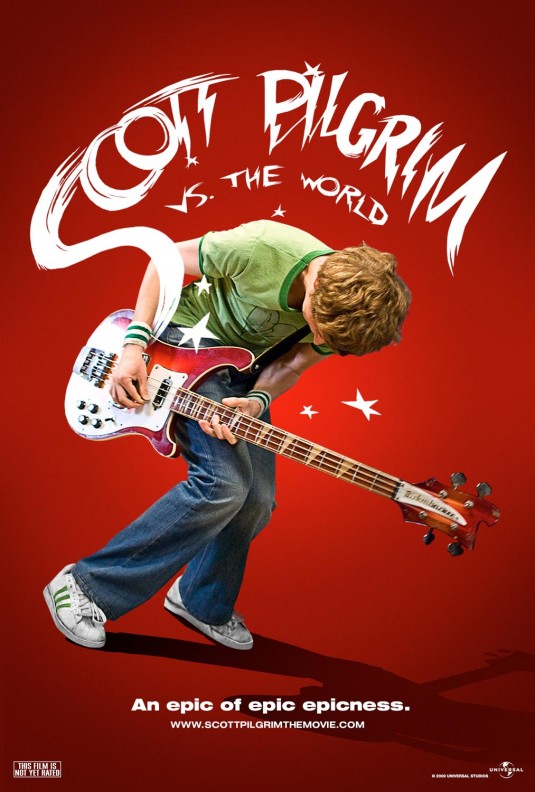 I don't normally interrupt my intended blog post ideas to talk about a movie -- okay, as far as any of you know, I don't generally interrupt my planned posts ever. On the blog, I can maintain a pleasant delusion that my whole life is entirely on purpose, and wouldn't that be lovely if it were true, but it isn't -- but I am interrupting my plans to talk about Scott Pilgrim vs. the World.
Yes, because I saw it on Tuesday night, and it was just that good.
When Captain Film Major first made me watch all the trailers -- yes, I'm reasonably sure he made me watch them all and here is commentary -- my initial reaction was, "This looks like a manga."
And why was that? Because it was based on a manga. Admittedly, I haven't read the manga yet, but I fully intend to check it out. (Yes, I read manga, and I refuse to be ashamed. ^_^ )
My second reaction: I must see this movie. The part that swayed me? Most likely that part in the trailer when he gets a life. (In case you're wondering, 2 minutes in. Go on, watch it. I'll wait.)
(No, seriously, I'll wait.)
When I get to the cinema, during the first 1.5 minutes, when you first see the blending of manga style and traditional film style, I first thought, "Oh, no, it's going to be a train wreck." Then, it smoothed out. By the end, they seemed to be blending the best of both styles. You got the humor of the cartoonish style and the chance to violate reality, and you also got the flow of movement not always present in manga and, let's face it, a bit more reality than is present in some things based on a manga series. (Yay for emotional continuity!)
Overall: This might actually constitute a 5 out of 5 stars, and I don't give those out often as you'd think. 5/5 :)
Cleanness: Minor swearing, light sexuality. I'd take a 13-year-old cousin to see this.
Violence: Minimal. That present is cartoonized. Zero gore. If a kid can hack Mario, they should be fine.
Tuesday, July 13, 2010
Where Do We Draw The Line?
I found myself vaguely surprised at the level of enthusiasm given to the question about MCs who cry, and cry, and cry. I think someone actually used the word 'drop-kick' in there. I could sense a clear line that people didn't like to see crossed.
This got me thinking. After all, I know when I'm reading, listening to, or watching a story, I have certain lines that I don't like seeing crossed either. Today, I'd like to discuss another line: interpersonal violence.
A while back, I watched the movie Chinatown for the first time. At one point near the end, Jack Nicholson's character slaps Faye Dunaway's character three times in rapid succession, because he believes she's lying to him. Now, let me make this clear, he's supposed to be the hero here, not to mention the romantic interest. For me, the slap was leaping head first over the line. I lost a lot of love for him in that moment.
Let me make this clear: as far as I'm concerned, the second a man slaps a woman, I'm gone. In my head, I'm thinking, "Honey, dump his ass," and maybe some other things in even less polite language. Barring unbelievably mitigating circumstances (to the point of he'd have to have done it to save her from certain death), I'd lose all love for that guy and encourage any girl he's interested in to head for the hills.
In a balanced perspective, I did once read a book in which the male lead slapped his wife without losing all of my respect. However, in that case, he was a spy in deep, deep cover, and if he didn't slap her, it would break his cover, and then they would both be brutally executed. And he did demonstrate soon afterward his regret for having done so and that the circumstances had necessitated it. In that case, I granted him an exception.
I guess it deserves to be said, if I came across a book in which a woman were beating up on a guy with whom she had contact, I like to think I've equal enough perspectives on society to have a similarly negative reaction to her. However, I don't know if I've ever come across a book in which the female was the physical abuser. (I say physical, because sometimes I think Bella from Twilight is emotionally abusive, but that might just be my view.) Has anyone come across a book with a female abuser?
How do you feel about interpersonal violence in books? Where do you draw the line? At what point would a character become unforgivable in your mind? Can you forgive things that might have crossed your preconceived line?
Wednesday, May 19, 2010
The Good, The Bad, and the Uninteresting
Sorry to vanish. Life intervened. Back. Miss me?
Over the weekend, I went to see a movie, which will remain unnamed, since I have a code against dissing things on my blog. (If you can guess the movie based on my remarks, I might not confirm it, but you should feel very pleased.) I'm not writing a negative review; but, I feel like I compelled to mention the movie anyway.
This movie had both an antagonist and a villain. They were separate individuals with separate reasons to hate the MC and work to counter his motives. They occasionally worked together, but they were not the same guy.
One thing I noticed half-way through the movie was that the antagonist really bugged me. Not just his personality, which was somewhat annoying, but all of him. Every scene he was in made me roll my eyes and consider ducking out for Sour Patch Kids.
It took me a only a little while longer to figure out why. He didn't change. Ever. Throughout the whole movie, the antagonist was always the exact bloody same.
That. Got. Old.
I'm sure, if you've been working on writing for a while, someone has told you that characters, over the course of a novel, need to grow and change. They cannot remain exactly the same. Readers will find that uninteresting.
When it comes to bad guys, I don't ask that they have periods of great moral development or that they experience some sort of deep internal change or that anything really meaningful and emotional occur with them. But, they cannot remain the exact same bad guy the entire time. Things need to change.
Why?
Because, for the MC, things must change, stakes must rise. And one of these ways in which stakes can/should/must rise is for the bad guys get more powerful. Otherwise, the MC is making steady progress against an unshifting enemy, which leads to the feeling that the MC is sure to win. That's not good.
The reader should not feel like the MC is certain to win. The reader should be sitting there thinking, "Oh, sweet sugar cakes, the MC is doom. There's no way they survive this." Stakes should be up there, or there's no reason for the readers to keep going.
During the movie in question, the villain changed. His motivations increased, so he acted more dramatically, which made him a more interesting and threatening villain. That makes me happy. The antagonist did not change or develop any new motivations. He had one goal throughout the whole movie and continued to approach it in the same manner and with the same level of tenacity. That makes me not happy.
In books, a similar situation would be equally frustrating. Characters need to have increasing motivations. They need to become more dedicated, more threatening, more determined. There should be more.
How do you feel about motivations over time? How do you feel about characters who do not grow?
Tuesday, March 16, 2010
Feeling Fabulous?
During discussion of what makes a good thesis, a teacher once said, "You're thesis should make you think, 'Wow, that's interesting. I want to think more about that.' You don't have to think, 'Wow, that's possibly the best idea I've ever had,' -- though that'd be good -- but you should certainly think you've hit upon something great."
That made me think of the Chaucer in A Knight's Tale. During one of the scenes, he's introducing William (the MC) to a crowd and gives one of his characteristically amazing speeches, and when the crowd erupts in applause, he cries, "God, I'm good."
(About 4:10 to 4:42, if you want to watch. Had to put up the video. Paul Bettany is that good.)
I think we all know that writing is not like that all the time. We often enough look at the a hundred words (you, you know, ten thousand words) and say, "What in the name of ice cream was I thinking? This is ridiculous?" Then the delete key becomes your best friend.
But, every now and then, we write something and think, "Okay, that was fabulous."
A while ago, my friend read the line in The Thief Book,"Charlotte could smell him from where she stood several paces off. 'Would it kill him to bathe?' she wondered. Flavian, it seemed, thought it would," and she laughed aloud. That made my day. I got to think, "Yes, I'm good. That's what I do this for."
I think that's what we all do this for. We sweat and stress and cry over wording, characterization, story, and all the first. We work our hardest, all for that moment when everything comes together and it works. And, maybe, for once, we get to think, "God, I'm good."
How you thought that lately, in writing or in life? What elicited the emotion?
Friday, March 5, 2010
Confidence -- I'm Pro
Yes, I'm in favor of believing in oneself. Shocking, I know. But, I think self-confidence is great.
What motivated these comments? I promise it wasn't just a desire to hear myself talk or an inexplicable love of tapping away at my keyboard. (Though both of those are fun, I could probably fill those without needs without yammering on a blog. Probably.)
Well, yesterday, I had a nice conversation with The Other One about a movie that we both enjoyed. (I'm not going to give the name here, sorry, because I'm about to give a slight critique of it, and I don't want to publicly diss a movie that was actually pretty good. So, I'm just going to take the learning experience, talk about it here, and leave the movie out of it.) My sister mentioned that the emotional arcs of the characters at the end were not very clear, which I also believed to be true.
The real flaw of with the emotional arcs wasn't that the writers weren't capable of getting them right, because they'd proved earlier in the movie that they were capable of sensical and moving emotional arcs. Nor was it the fault with the actors, because they'd already demonstrated in the film the necessary skills.
The problem was that the scenes necessary to convey the emotional shifts in the characters and the changes in the relationships involved (these things were only hinted at in the final film, leaving the audience the work of figuring out what they'd missed), these scenes were not in the film. They were skipped over with the expectation, as far as I could tell, that the viewer would pick up the slack.
(Now, this could be a moment where I talk about Don't Make Your Reader Work So Hard, but I'm going to save that for another moment and talk about my intended topic. [Me staying on topic, that might actually me a shocker for y'all. Woah.])
It seemed to me that this problem displayed a lack of confidence in their on the part of the filmmakers. (This is the point when The Other One told me I was over-thinking. I do not concur. I believe I am thinking just the right amount.) I think they did not have those important scenes because they didn't have enough confidence in their project.
What I think happened is that they worried the movie would run too long and they would lose the attention of their audience. Their solution: Shorten the movie to a length that the audience would willingly pay attention. The problem: They cut important stuff to get it as short as they wanted it.
First of all, they didn't need to shorten it. They had me. I would have gladly watched the extra 10 or 15 minutes they'd have needed to fill out the emotional arcs at the end.
But, if they didn't think they had everyone, then the right answer would not have been to create an inadequate ending (endings are important. For my thoughts on endings, click here.). What they should have done was go back to the beginning and middle and made sure that every scene was sufficiently amazing so that by the time the end came about the viewer would gladly sit for 10 or 15 minutes to finish up the emotional arcs properly.
This seems to me to indicate a lack of confidence in the caliber of their work. They didn't believe it could hold my attention.
We, as storytellers, need to believe in ourselves and our stories. We need to believe in the capability of our writing to hold the attention of readers. And if we don't think what we have is capable of doing that, we need to believe that we are capable of improving it enough to hold the readers attention.
We need to believe in our work and its ability to rock.
How's your writerly self-confidence right now? How important do you think confidence is?
Friday, January 29, 2010
To Infinity And Beyond
Well, in this, my final post related to Stranger Than Fiction (for the time being, at least. I make no promises about eternity), I'd like to throw out a quote from a character whose name I've forgotten but I call in my head Awkward-Friend-Guy. In response to the question what he'd do if he thought he were going to die, he said, "Easy. I'd go to space camp." Bear in mind, this guy is at least 30. When the MC asked him if he weren't just a little old to be going to space camp, Awkward-Friend-Guy replied in all seriousness, "You're never too old to go to space camp, dude."
"You're never too old to go to space camp." You are never too old to go after your dream. (If your dream is to run with the bulls in Pamplona, I might suggest rigorous training in advance and getting on that goal now. But who am I to set an age limit on running with the bulls? You know your limits better than I, bull-runners.)
Let me expand this to both ends of the spectrum. You are also never too you to start pursuing your dreams, either. You are never to young to plan the adventures you'd like to have, write that novel, learn to speak Portuguese in preparation for the day you get marooned in Lisbon by your pirate comrades.
Age is rarely a factor in what you want. (Unless what you want is a driver's license, in which case the government might take issue with your time of birth. DISCLAIMER: I am not encouraging anyone to violate the law of your state/province, your country, or physics. Please check with your local officials and appropriate medical person before attempting bullfighting/flight/marionette racing, etc.) The right time to start going for what you want is now.
Now.
Don't let anything hold you back. 'I haven't seen enough/done enough/learned enough.' You can learn more, figure out more. Get smarter, get wiser. These things can be achieved. They aren't time sensitive. Strike while the iron is hot and get what you're going for.
Do you often feel like you're questioned about what you want or feel unable to achieve it because of your age level? How important do you think age is to writing? Does age correlate to experience?
Thursday, January 28, 2010
Packing Peanuts
This post is also related to the movie Stranger Than Fiction. And, I'm once again going to quote Dustin Hoffman's character, who amused me way too much. "Meeting an insurance agent the day your policy runs out is a coincidence. Getting a letter from the emperor saying he's visiting is plot. Getting your apartment eaten by a wrecking ball is something else entirely."
First of all, I've never had any domicile of mine consumed by any piece of heavy machinery, so I don't know if I'd consider it a plot-esque moment if it happened to me, but I'd probably call it 'something else,' too.
My alpha calls the 'something else' filler. (I do not dispute that there can be other varieties of 'something else,' however, I'm going to discuss the filler aspect only in this post.) Well, filler has never been something I'm super good at, but it's actually much more important than it sounds.
Filler is the stuff that happens in between Big Events. Not everything that happens in the story can be a Big Event. There has to be some lower key things to balance it all out, otherwise your Big Events won't look so big anymore. Also, it smooths things out between Big Events, so it doesn't feel like you're bouncing from Event to Event. It eases the transition.
The filler can be a subplot or a minor story arc created for the purpose of filling the time. As long as it gives the reader something to think about betwixt the more important things you really want their attention on.
One of my favorite examples of filler material is pretty much all of the Quidditch stuff in Harry Potter. (I remember a while ago, s omeone mentioned in the comments section that they hadn't been able to figure out what the purpose of the Quidditch was. I'm sorry I've misplaced your name in my mind, however I am remembering you as I type this.) They might not be furthering the main plot or any of the major subplots; however, they are interesting to the readers and are something the reader can focus on while time has to pass and things have to stew.
I'm not so good at the filler stuff. I do the bouncy-bouncy thing with my Big Events, probably because it's the Events that come to me. I have to find the fill-in-the-blanks stuff along the way to get from A to B and hopefully all the way to Z eventually. But I know I need to get better at it. Otherwise, I might just leave my reader feeling like I'm racketing them from point to point.
How do you feel about filler? Do you use enough of it/not enough of it? Do you like it in books? If so, what kinds?
First of all, I've never had any domicile of mine consumed by any piece of heavy machinery, so I don't know if I'd consider it a plot-esque moment if it happened to me, but I'd probably call it 'something else,' too.
My alpha calls the 'something else' filler. (I do not dispute that there can be other varieties of 'something else,' however, I'm going to discuss the filler aspect only in this post.) Well, filler has never been something I'm super good at, but it's actually much more important than it sounds.
Filler is the stuff that happens in between Big Events. Not everything that happens in the story can be a Big Event. There has to be some lower key things to balance it all out, otherwise your Big Events won't look so big anymore. Also, it smooths things out between Big Events, so it doesn't feel like you're bouncing from Event to Event. It eases the transition.
The filler can be a subplot or a minor story arc created for the purpose of filling the time. As long as it gives the reader something to think about betwixt the more important things you really want their attention on.
One of my favorite examples of filler material is pretty much all of the Quidditch stuff in Harry Potter. (I remember a while ago, s
 omeone mentioned in the comments section that they hadn't been able to figure out what the purpose of the Quidditch was. I'm sorry I've misplaced your name in my mind, however I am remembering you as I type this.) They might not be furthering the main plot or any of the major subplots; however, they are interesting to the readers and are something the reader can focus on while time has to pass and things have to stew.
I'm not so good at the filler stuff. I do the bouncy-bouncy thing with my Big Events, probably because it's the Events that come to me. I have to find the fill-in-the-blanks stuff along the way to get from A to B and hopefully all the way to Z eventually. But I know I need to get better at it. Otherwise, I might just leave my reader feeling like I'm racketing them from point to point.
How do you feel about filler? Do you use enough of it/not enough of it? Do you like it in books? If so, what kinds?
Wednesday, January 27, 2010
Forward Motion
During the movie, Stranger Than Fiction, as two characters attempt to foil the plot (not a maniacal one, an authorial one), one, who is a lit prof, says, "Some plots are moved forward by external events and crises. Others are moved forward by the characters themselves. If I go through that door, the plot continues. The story of me through the door. If I stay here, the plot cannot move forward, the story ends." To me, those were words of sheer genius. They summed up quite simply what sometimes writers, including myself, forget.
Plot = Life.
Plot is the story moving forward. Now, I'm not going to get drawn into a debate about what forward motion is better, plot or character, because both have their purposes. However, either way your story is moving, it's got to be moving in some respect. The characters should be growing. People should be pursuing their goals. Stakes should be shooting sky high.
If the plot does not move forward, your story will end. Or, it should end, because if your plot is over, there's nothing more for the reader to watch. So, you don't really get to take breaks of non-plot in the middle of your story, because the reader is going to think that's the end, close your book, and walk away. Your reader walking away is the end of your story whether you were done telling it or not.
The problem with not moving the plot forward is quite simple -- it's killing your tension. You've got everything set up. Everyone's invested. Protagonists are struggling against impossible odds, antagonists are making things hard as heck, and everything is as it should be mid story land. But if you just off the plot to meander down some side path of nothingness, your reader is just going to think, "I'm sorry, what just happened there? Where'd the story go? Why is happening?" And then they'll put down your book to go watch 24 or House or some other show, where things are probably happening.
I'm not suggesting that the main plot of the story always be in constant discussion. However, even times when it feels like the author has let the main plot sit and stew for the time being, there are usually subplots or minor story arcs that are being treated during that time. Though the plots at work at minor, it is not a moment bereft of action pulling the story on.
Plot is life. Without it, you stand a strong risk of losing your reader's focus.
How do you feel about moving the plot forward? How much down-time can you have before the reader gives up? Do you like some down time with not much going on in your reading?
Tuesday, January 26, 2010
Oh My Golly, Did You Just See That?
During a scene on a bus in Stranger Than Fiction, the narration informs the viewer that the MC is stopped at the intersection of Euclid Avenue and Born Boulevard. In case those names don't sound connected, I should tell you that Love Interest Girl's name is Miss Pascal. Euclid, Born, and Pascal. Those are all the names of famous mathematicians. Euclid wrote a book about geometry. Yes, that is the Pascal of triangular fame. I didn't know about Born until I googled him, but he was a famous German mathematician.
Now, you're probably wondering why I found this all so amusing. Well, the MC works for the IRS and is very good at mathematics. So, the names of all the mathematicians are sort of a joke. (Either that or the writers just chose the darnedest names. Which, I guess, they could have done. I've not real proof for my suppositions here. It's not like I know them personally.)
Sometimes, people sprinkle little jokes like that throughout the text. Minor references to things related to the subject at hand. I find them funny, and I think they indicate a certain level of thought and consideration in a text, which is always nice.
True, these are only funny if the reader understands what you are doing. For example, if the person watching Stranger Than Fiction didn't know anything about geometry, they probably would have missed some of the math jokes. But, if you got the joke, it was rather cute. So, these referential jokes are only funny if they're references to things people will understand.
Actually, in one of my shelved works, all of the school teachers have the surname of a person who attempted to assassinate a US president. I don't really know why I did that, except that I was listening to the musical Assassins a lot around the time I started, so when I reached for a name, I grabbed Fromme. Well, the pattern formed. I'll probably have to remove the pattern if I hope to do something with that book, but for the moment, it amuses me.
Do you leave patterns and little motifs in your work? Were there any such motifs in books or movies that have amused you in the past? Do you like this idea, or do you think it's odd.
Monday, January 25, 2010
Muse Musings

In the movie Stranger Than Fiction, Emma Thompson plays an author struggling with how to write the end of her novel. She does several unique things to try to figure out the ending, including sitting outside in the rain. When her assistant tells her that sitting in the rain doesn't write books, she replies, "Well, that shows you just how much you know about writing books." When she finally figures out the ending, she tells her assistant, "Like anything worth writing, it came inexplicably and without method."

Answers like that call to mind, for me, strange people huddled in cafes with cigarettes and alcohol talking about their 'genius' and their 'muse.' People I called 'artistes' and thought of as divas who needed careful handling, because they couldn't just put their butts in chairs and get something accomplished.
I do not believe I have a Muse. I do not believe there is some person or thing who causes my ideas and whose absence will cause my mind to dry up like a well. Ideas tumble off shelves in my brain, but I don't know if there's anything I could do to induce them to fall other than kick a lot of stuff around in an effort to help mental gravity out a bit. If one thing's for certain, pouring libations and sacrificing goats does not help my creative process.
However, I cannot deny that sometimes the whole story idea, the key aspects of the tale, or the brilliant thing that I love came to be in some sort of flash. Often there's a glimmer of a hint of a thread, and I'll follow that to the end of the thought process. But, sometimes, things walk up and announce themselves. Inexplicably and without method.
Do you have a 'muse'? How do you get those illusive muses to sing/dance/produce ideas from thin air? If you don't have a muse, what do you do to get the creativity to work when it doesn't want to?
Thursday, January 21, 2010
Those Magic Words
Okay, I'm about to mention Avatar again. **ducks to avoid being hit with thrown objects** I can fully understand if you're thinking, "Oh my golly goodness gracious, are you kidding me?" I promise you, I did not set out to make this some sort of Avatar themed week or anything like that. Plus, I promise to connect this back to the things I said yesterday, so try to just think of me as smart or clever or something along those lines.
When people ask how I liked Avatar better than so many other movies that most would consider equally good, I have sometimes replied, "It told me things I like to hear." That may sound strange, but I think it's true.
All things with stories have a message or a set of beliefs around which the story is based. And, if you are partaking of those products, you have no real way of avoiding said beliefs or messages. For example, if you read the Harry Potter Series you had as good a chance of missing the message "Love triumphs over all evil" as I have of learning how to turn marbles into steaming hot cups of tea with milk. (If you missed that message, go back and read the books again. It was there.) No matter what you're reading or watching or listening to, you are being told something by the maker.
And, the very important question is, do you like what you are hearing?
A while ago, a class I took required us all to read the book Ishmael by Daniel Quinn. (A very good book. I would highly recommend it, especially if you liked Avatar.) Well, about 2/3 of the class declared that the book had changed their lives and that it was awesome. I figured the book hadn't changed my life, because I'd already agreed with what the author was saying, but it told me things I liked to hear, and I declared it to be awesome. My sister (hereafter known as The Other One) said it didn't change her life and hadn't told her much she didn't already know; The Other One declared the book to be good, but definitely not life changing. It didn't tell her things she liked to hear.
What people like to hear is sort of like a demographic all of its own. "People who like to hear this sort of thing" could be a target audience in its own right. The message of the story can be just as important as genre and other target audience factors, if not more so, in determining whether or not an individual likes the book/movie/epic poem, etc.
In my life, I'm not a fan of sports, but there are some movies about football and rugby that I love, because the message about growth and interpersonal understanding is one that I enjoy. The message beat out 'genre' for me in those cases. Some books, I know, no matter how well written they are, I will never enjoy them, because the philosophy of those books just makes me want to chuck that tome against a wall. (Not that I would mistreat a book like that, but sometimes the stuff I'm reading just makes me want to drop-kick something. Maybe I should post a warning sign before reading books like that.) The message overwhelms the other aspects of the book for me.
How do you feel about art /books/movies saying what certain people like to hear? Does such a phenomenon effect your reading and buying?
Subscribe to:
Posts (Atom)


